
The Quick Answer
Upgrading your mass airflow sensor’s (MAF) housing isn’t about reducing intake restriction—it allows the ECU to measure more airflow, enabling accurate tuning at higher power levels.
How the MAF Sensor Works
The MAF sensor uses a heated resistor to measure the mass of air flowing into your engine. Here’s what happens:
- Air flows past the heated resistor, cooling it down
- The more cooling, the more voltage flows through the resistor
- The ECU reads this voltage to calculate how much air is entering the engine
- Maximum sensor output is 5 volts—once reached, the ECU can’t register any additional airflow
Why Upgrade Your MAF Housing?
A larger MAF housing slows down the air velocity passing the sensor. This means:
- Less cooling of the resistor at the same airflow
- Higher total airflow before hitting the 5V limit
- Accurate ECU readings at higher boost and power levels
MAF Housing Size vs. Power Capability
Stock M4.3/M4.4 MAF Housing
- Maximum measurable airflow: 826 kg/hr
- Approximate power limit: ~225 WHP
- Suitable boost: up to ~14 psi on 18t/19t/20t/22t/K24 turbos
960 MAF Housing (3″ diameter)
- Maximum measurable airflow: 1,107 kg/hr
- Approximate power limit: ~310 WHP
- Recommended for: any turbo with a TD04HL hot side or K24
3.25″ MAF Housing
- Recommended for builds targeting 330+ WHP
What Happens When the MAF Maxes Out?
Running beyond your MAF’s measurement limit creates serious tuning problems:
- Incorrect load calculation: The ECU thinks engine load is decreasing (due to perceived drop in volumetric efficiency) when it’s actually increasing
- Lean fueling: ECU reduces fuel injection—exactly the opposite of what’s needed at high loads
- Dangerous timing: ECU advances ignition timing when it should be pulling timing for safety
- Impossible to tune: You cannot accurately tune an engine when the ECU doesn’t know the true airflow
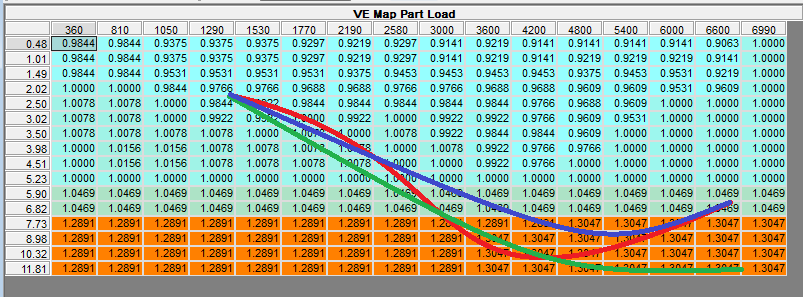
Here is a visual of what it looks like in tuning. The red line represents the curve that the ECU will calculate with a maxed MAF. You can see at 4200 the MAF becomes maxed and the load starts to decrease. The green line represents a non-clipped MAF, where the ECU is reading the correct amount of air entering the engine – the load increases and then stays constant. The blue line is a pull in which the MAF hasn’t been maxed, and as you can see it traces some of the same cells as the red, clipped MAF pull.
How to Install a 960 MAF Housing
What You Need
The upgrade is simple: you reuse your factory Bosch MAF sensor in the larger 960 housing. This means you can buy the cheapest 960 MAF available—you only need the housing itself.
Compatibility Note (92-98 P80s)
The 960 MAF housing will not directly connect to the factory pre-turbo intake tube on 92-98 P80 vehicles. You’ll need one of these adapter solutions:
- Snabb intake pipe — Replace the 2.75″ right angle coupler with a 2.75″ → 3″ right angle reducer
- DO88 intake tube — Get the version designed for 99-00 P80s, which has a 3″ inlet
- Factory intake tube — Volvo part number 9445351 (from 99-00 P80)
For the air filter, we recommend using the factory airbox. It’s quite a good design with a large filter area and a snorkel which pulls in cool, outside air. To use the factory airbox with the 960 MAF housing, source a 1999-2000 airbox lid. These cars came from the factory with a 3″ MAF housing.
We do not recommend running a cone filter open to the engine bay. While an unshrouded cone filter will make turbo induction noises louder, the car will be slower. With the engine pulling in hot engine bay air, your car will tolerate less ignition advance.
For those running a stock airbox – do not use a K&N filter! The oil required for proper filtration of a K&N filter will bake onto the MAF sensor, causing it to fail.
Important Warnings
Don’t Oversize it
Using a MAF housing larger than necessary can cause problems, such as:
- Decreased airflow measurement resolution
- Degraded idle quality
- Increased difficulty in tuning
Avoid the BMW 540i MAF Housing
While this has been recommended in the past, the BMW 540i MAF housing does not properly center the Volvo MAF element. This makes accurate tuning very difficult or impossible. For 350+ WHP builds, use a custom aluminum MAF housing instead.